
At first glance, the title of Lee Chang-dong’s new film Possible Love sounds more like a romantic K-Drama than a prestige film from an international arthouse favourite. Since the film is distributed by Netflix—home to many romantic K-dramas—the title may draw unsuspecting audiences to director Lee’s new film, his first since 2018’s Burning. However, rather than romance, Possible Love delivers complex character dynamics, slow-building tension, and a treatise on worker solidarity, wealth inequality, and the exploitation of labor under global capitalism.
Wealth inequality has been a key topic among Korean filmmakers in recent years, and Lee Chang-dong is now the third great Korean auteur to tackle familial bonds under late-stage capitalism—following in the footsteps of Bong Joon-ho’s Best Picture winning film Parasite, and last year’s No Other Choice from director Park Chan-wook. In Possible Love, director Lee dispenses with all genre trappings and delivers a straight drama focused on the deep psychological and emotional impact of capitalist exploitation, and the friction that can happen when two families from opposite sides of the wealth divide meet.

Possible Love focuses on Ho-seok (played by Sul Kyun-gu) and his wife Mi-ok (Jeon Do-yeon), a working-class couple struggling to stay positive as they deal with the financial, emotional, and psychological ramifications of Ho-seok’s recent layoff. This is challenging for Ho-seok, whose identity is so strongly tied to his work that they have named their son after Ho-seok’s industry (“Cheol” as a reference to steel, gangcheol). Their lives are upended by the introduction of a documentary filmmaker (Cho Yeo-jeong, in a role similar to hers in Parasite as a wealthy homemaker), who is interested in making a film about the recent layoffs. She is married to a wealthy husband (Zo In-sung), who appears skeptical of his wife’s goal.
The whole cast of Possible Love delivers strong performances. Cho Yeo-jeong once again demonstrates her excellence at portraying the strategic naïveté of the rich wife. As director of the documentary, she seems blissfully unaware of the wealth gap between her and her subjects, deluding herself into imagining that she is genuinely helping these people. At one point, she expresses disappointment that the factory footage is not entertaining to watch because it is too boring and repetitive. Jeon Do-yeon is also brilliant as the poor wife Mi-ok, constantly teetering on the edge of emotion, desperate for attention, warmth, and security. Mi-ok is tired and could cry or fall in love at the drop of a hat. Meanwhile, her husband Ho-seok is a boiling kettle. Sul Kyun-gu brings fantastic presence here, so full of tension that he feels legitimately dangerous in every scene.
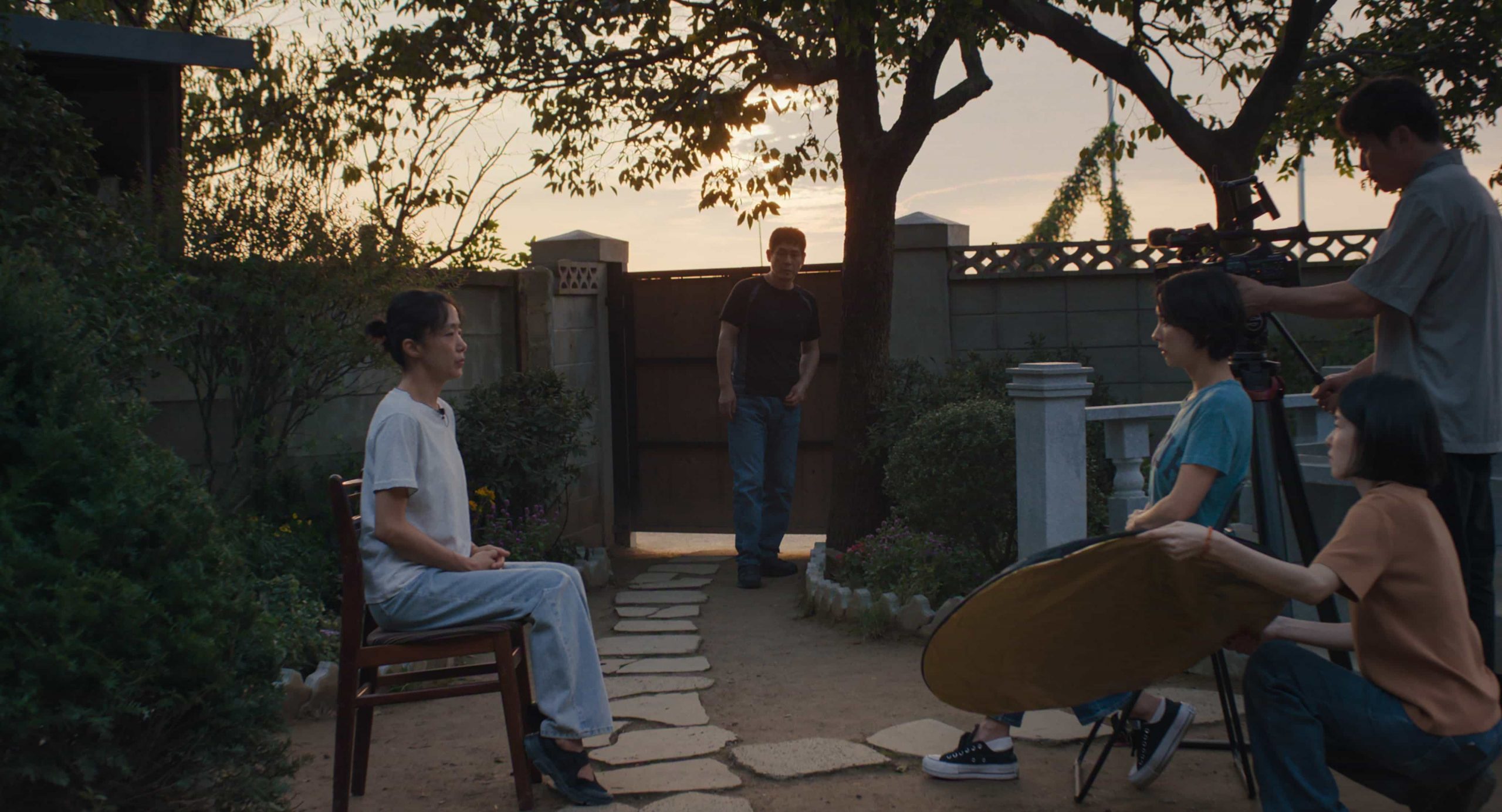
Possible Love is a thematically rich, novelistic film. Aside from its examination of wealth inequality under capitalism, it is primarily a character drama, exploring the complicated relationship that develops between these two couples, as they oscillate between envy, romantic tension, hidden resentment, and genuine warmth. Possible Love also explores the inherently exploitative nature of documentary filmmaking, revealing it as a tool of both catharsis and activism, but also one of voyeurism, treating the couple as subjects for a film rather than as humans. The irony is thick, as the director making a film about exploited wage labor laid off due to corporate restructuring is also the wife of a wealthy business tycoon and films her subjects while wearing designer clothing and carrying luxury bags.
At times, Possible Love feels sprawling and unwieldy, as director Lee tries to stuff all of these ideas into the film’s nearly 3-hour runtime. Certain scenes may also err on the side of being too thematically explicit, with characters directly saying that which may be better inferred. However, there are some real sublime moments, such as a shot near the end of a character using a garden hose. Echoing a scene from earlier in the film, it is a shot loaded with meaning.
Given this review emerges from 2026’s Vancouver International Film Festival (VIFF), it is worthwhile to note some interesting thematic pairings emerging among VIFF—and other major festivals’—headliners this year: Club Kid and Fjord both explore ideas of who deserves to be a parent, while Possible Love would pair well with the Japanese film All of a Sudden, another 3-hour drama about the working class struggling to find humanity in the face of executives interested in maximizing profit at the expense of human workers. Ultimately, even if viewers may not find much romance in Possible Love, they are unlikely to come away disappointed.
• • •

Possible Love (Korean: 가능한 사랑 / Ga-neung-han sa-rang)—South Korea. Dialog in Korean. Directed by Lee Chang-dong. Running time 2 hour 44 min. First released September 6, 2026 at the Venice International Film Festival. Starring Jeon Do-yeon, Sul Kyung-gu, Zo In-sung, Cho Yeo-jeong.
This article is part of Cinema Escapist‘s dedicated coverage of the 2026 Vancouver International Film Festival.