
Manila’s Finest starts in 1969, a pivotal time in the Philippines. That year, president-turned-dictator Ferdinand Marcos won an unprecedented second consecutive term, which plunged the country into an economic crisis and social unrest.
The Marcos era (1965 to 1986) is familiar territory for Raymond Red, as it heavily influenced his creative choices. Red is widely regarded as a pioneer of modern Filipino independent and alternative cinema. Manila’s Finest marks his highly anticipated return to directing after a decade-long hiatus—following his niece Rae Red’s departure from directing the film.
Raymond Red’s works are renowned for their experimental style and deep dives into systemic corruption; they frequently highlight the struggles of the marginalized, and showcase characters striving to uphold their personal values within an oppressive society. Red explores similar concepts in Manila’s Finest, ultimately asking: “Where are all the good people? What defines them?”
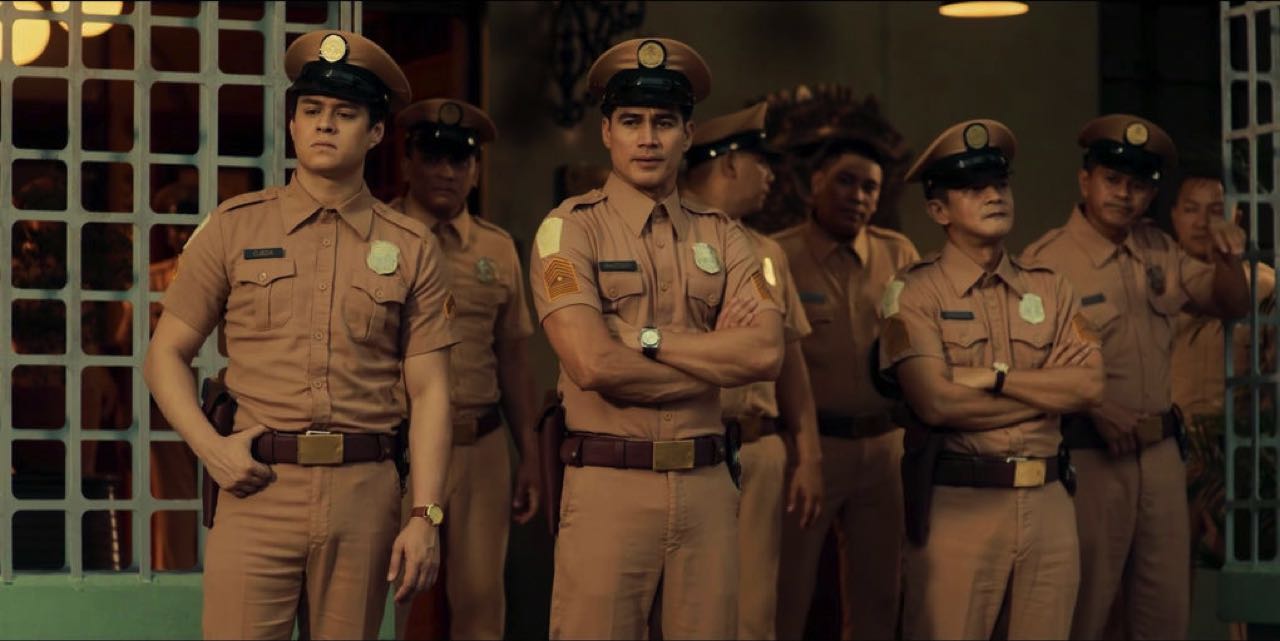
The historical drama is set during the First Quarter Storm, a period of civil unrest marked by demonstrations and marches against the Marcos administration from January to March 1970—just before Martial Law, which lasted from 1972 to 1986. In the movie, Manila policemen Homer Magtibay (Piolo Pascual), Conrad Belarimino (Ariel Rivera), and Billy Ojeda (Enrique Gil) are rocked by a series of deaths and protests, and clash with the Philippine Constabulary Metropolitan Command (a.k.a. MetroCom, the paramilitary force used by Marcos to enforce Martial Law).

Screenwriters Michiko Yamamoto, Moira Lang, and Sherad Anthony Sanchez paint these policemen as flawed characters, and portray the hypocrisy around traditional standards of masculinity. Indeed, despite their clean-cut image, tight button-up shirts, and polished shoes, these cops do rather unsaintly things. Homer is unfaithful despite being a family man, Billy occasionally gets drunk on the job, and both officers beat up troublemakers for quick money. These policemen are supposed to be dignified defenders and protectors but, as their country becomes plagued with institutional decay, they become less and less of what they should be.
Red confronts this deterioration slowly, taking his time to show that the dictatorship didn’t happen overnight. The political shift exists in hushed whispers and hearsay. His approach starts small until arrests and deaths follow, eventually reaching even the police ranks. This portrayal of MetroCom’s takeover rejects typical procedural drama—there’s no scheming from powerful figures, melodramatic backstabbing, or explosive climax, just the fallout from it. Red tries to offer a glimpse of hope through Homer, who, despite his moral failings, wants to do good, perhaps prompted by seeing his own daughter Agnes (Ashtine Olviga) join protests against the government. That said, Red’s message is clear: wanting to do good is not enough, because actions speak louder than desires.

The Philippines suffers from back-to-back corruption scandals, political drama among top officials, and an ex-president who justifies extrajudicial killings. The need for accountability and collective responsibility is just as relevant today as it was decades ago. Manila’s Finest also clearly highlights the issue of nepotism, with several policemen achieving high ranks because of relatives who are or were in powerful positions. This perhaps echoes how political dynasties have dominated the Philippines for years, with the sitting president—ironically, Marcos’ son—as a prime example.
Digo Ricio’s period-accurate production design also makes Manila’s Finest feel authentic to its era, for example, with scenes set in the preserved streets of Escolta and Binondo. The film also truly excels when its natural colors are permitted to break through, as opposed to the moments when it relies on sepia tones to establish a vintage look. Red, who also serves as Director of Photography, seamlessly shifts between wide and long shots to effectively capture Manila’s landscape.

Piolo Pascual is also an excellent choice for the lead role of Homer, one that both matches and contrasts with Pascual’s clean-cut image as one of the Philippines’ most respected actors. Meanwhile, despite only appearing briefly, alternative rock band Rivermaya’s former frontman-turned-actor Rico Blanco becomes an absolute scene stealer with his eccentric performance as police chief Epifanio Javier.
That said, Manila’s Finest is very much told from the male gaze. Female characters such as Homer’s wife Yoly (Rica Paralejo, who returns to acting after a long hiatus) and his lover Janette (Jasmine Curtis-Smith) exist only in the background, without much agency. There is an attempt at female representation with Ashtine, who delivers an important line in the film. However, the film otherwise sidelines her most of the time—a missed opportunity to incorporate how women navigated the turmoil of the Marcos era.
With Manila’s Finest, Red showcases his experimental approach and refusal to cave into standard drama. The film is not a popcorn blockbuster, but instead a nostalgia-filled watch that seems to say the Philippines needs justice, not saints.
• • •

Manila’s Finest—Philippines. Dialogue in Tagalog. First released December 25, 2025, at the Metro Manila Film Festival 2025. Running time 1hr 59mins. Starring Piolo Pascual, Enrique Gil, Cedrick Juan, Ashtine Olviga, Jasmine Curtis-Smith, Rica Paralejo, Romnick Sarmenta, Joey Marquez, Rico Blanco, Edwin Pamanian.
This article is part of Cinema Escapist’s dedicated coverage of the 2026 New York Asian Film Festival.