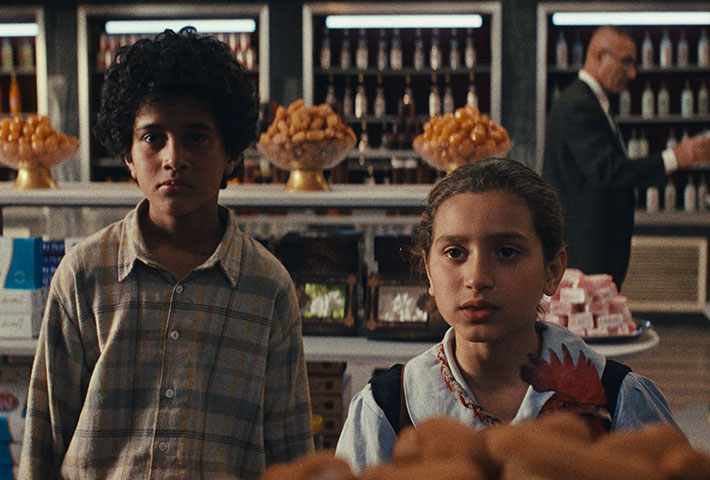
Overwhelming American firepower rains down onto an oil-rich Middle Eastern country, decimating its military. Unwilling to stomach an extended occupation, the US declares victory whilst leaving the country’s brutal regime intact. Sanctions, a no-fly zone, and empty promises to a suffering civilian population are all that remain. This is the reality not of 2026 Iran, but rather 1990s Iraq—the setting of The President’s Cake, a standout film that debuted at Cannes 2025 and has now expanded into global theatrical release.
The President’s Cake is not some cerebral treatise on the distant callousness of US foreign policy, though American power looms—and sometimes booms—as a constant specter. Rather, it’s the bittersweet story of a nine year old girl named Lamia who has the misfortune of getting selected to bake a cake for her school’s celebration of Saddam Hussein’s birthday. While Saddam himself never appears in the flesh, his presence—through mindless slogans and constant propaganda posters—seeps into every corner of Lamia’s existence, like rancid honey sticking to countertops. Failure to produce a cake, Lamia’s teacher warns with the cautionary tale of a former student, could bring the state’s wrath upon her family.
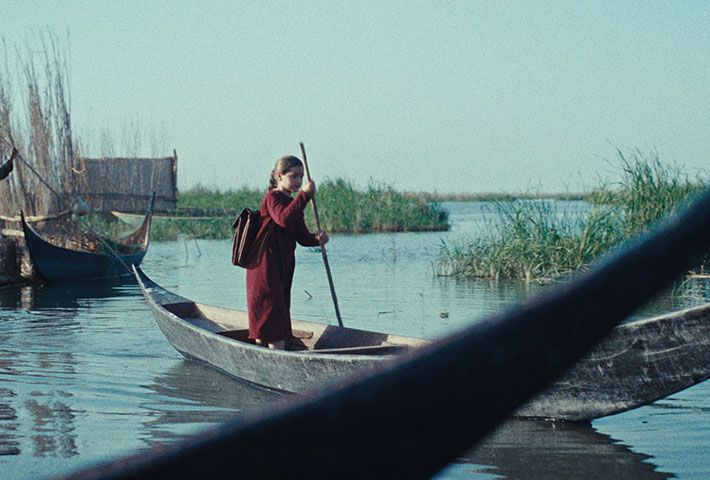
Lamia’s parents are dead—so the burden falls upon her aging grandmother to help procure ingredients for this absurd yet devastating assignment. Barely eking out an existence in their thatched reed hut within the scenic but hardscrabble Mesopotamian Marshes, Lamia and her grandmother gather family heirlooms and embark on a journey to Baghdad. There, perhaps, they can find the luxuries of eggs, sugar, and flour that elude the everyday denizens of sanctions-afflicted Iraq.
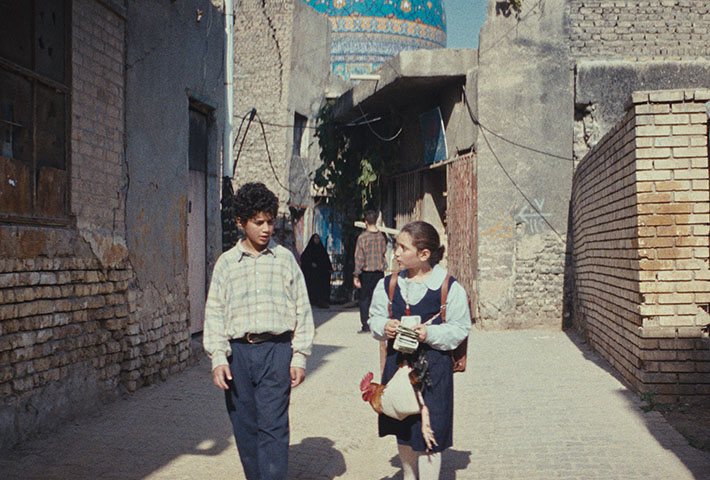
When Lamia discovers her grandmother intends to have another family raise her instead of helping her actually make a cake, she runs off to complete the assignment herself, enlisting the help of her classmate Saeed—who has a complementary mission to procure fruit for Saddam’s birthday. The two stumble around Baghdad in a series of tragicomic attempts to procure cake ingredients by any means necessary. Despite the two protagonists’ chemistry and initial aplomb, the indignities of postwar Iraq begin to erode their innocence—one scammer, scoundrel, and sexual deviant at a time.
Yet, The President’s Cake never plunges into the emotional devastation of, say, the Kurdish film Turtles Can Fly, which tells a story of children in Iraqi Kurdistan around the same time period. Much credit goes to Baneen Ahmad Nayyef and Sajad Mohamad Qasem, the non-professional child actors who play Lamia and Saeed respectively. The pair demonstrate remarkable range, somehow managing to balance youthful effervescence with muted disappointment especially through body language and facial expressions—with the film’s final shot as perhaps the most standout example. Even when all seems lost and their innocence washed away, Lamia and Saeed can still look into each other’s eyes and share in both the joys and agonies of existence.
All this is especially remarkable given contemporary Iraq’s relative lack of a filmmaking ecosystem. Director Hasan Hadi has shared in interviews how he had to assemble an entirely non-professional cast given Iraq has no regular pipeline of actors, for instance. In fact, this is probably the only movie from federal Iraq in the last few decades to attain wide global distribution, and almost certainly the only one to touch upon the 1990s from the viewpoint of southern Iraq’s predominantly Shia communities, as opposed to the Kurdish perspectives that films like Turtles Can Fly and Kilometer Zero—both of which have thematic and visual similarities with The President’s Cake—have shared with international filmwatchers.
The choice to center The President’s Cake in southern Iraq also proves creatively fruitful. Orange-blue twilight shots of the Mesopotamian Marshes that Lamia and Saeed hail from represent a splendid look at one of the world’s most picturesque regions, one that has featured in Western documentaries and photography collections but never an Iraqi film. The Ziggurat of Ur also provides the backdrop to one of the most visually resplendent framings of a military checkpoint in recent cinematic history, and the film’s shots of Baghdad’s bridges, alleyways, and rooftops come straight out of a tourism advertisement. If there is one flaw to The President’s Cake though, it’s the uneven pacing of Lamia and Saeed’s trials and tribulations in Baghdad, which do not escalate in a linear way and contain a couple of somewhat duplicative plot elements. t
Nevertheless, The President’s Cake represents a triumph of Iraqi cinema. Like its protagonists, the film demonstrates a resourcefulness amidst constraints that yields beautiful dividends. Especially as history repeats itself yet again in Iran, Gaza, and beyond, The President’s Cake remains a timely reminder of the innocence crushed beneath fragile, incomplete peace.
• • •

The President’s Cake (Arabic: مملكة القصب)—Iraq. Iraqi Arabic. Directed by Hasan Hadi. First released May 16, 2025. Running time 1hr 45min. Starring Baneen Ahmad Nayyef, Sajad Mohamad Qasem, Waheed Thabet Khreibat, Rahim AlHaj.