Director Kim Jin-yu likes to take his time. He lets scenes unfold naturally and his characters interact freely, guided by an observational, humanist approach. He demonstrated as much in his stunning 2018 debut, Bori, and returns to it eight years later with his latest feature, Journey There.
Journey There follows Chun-hee (veteran actress Kim Hye-ok), an elderly woman grappling with the sudden death of her husband. After moving to an apartment complex, she meets Min-jun (Justin H. Min, in his Korean-language debut), a German-Korean adoptee searching for his birth mother. The two form an unlikely bond.
The film unfolds like a letter: Kim opens with a voiceover of Min-jun reading words written by Chun-hee, establishing that she is moving on and leaving behind the house her husband built. This device feels jarring at first, almost out of place, but its purpose becomes clear as the letter builds toward Chun-hee’s fate by the film’s end. Despite such heavy material, Kim’s approach stays delicate and gentle rather than melodramatic.
Director Kim renders Chun-hee’s grief through her actions: she cleans a house she no longer lives in, tends a piano she doesn’t play, and maintains a car she doesn’t drive, all evidence of her refusal to let go. She treats these objects not as things but as living companions. Min-jun, meanwhile, copes through alcohol. Despite their age gap and contrasting personalities, Kim shows that grief is intergenerational—Min-jun’s carefree nature stands in contrast to Chun-hee’s devotion to routine, yet both wrestle with the same ache of longing.
Visually, the film is filled with vivid colors and postcard-like landscapes. Kim favors long takes for a lingering effect that mirrors Chun-hee’s sense of days slipping past her. Cherry blossoms fall, rain comes down, the sun rises and sets, waves crash—and through it all, Chun-hee remains still, watching as everything around her moves while she does not.
Cinematographer Lee Kun-sol makes striking use of natural light and reflections, contrasting the bright outdoor landscape with a darker palette indoors—in the car, the house, the hospital. Kwun Hyun-jeong’s score has a life of its own, too: the piano pieces mirror the scenery, with characters describing them as a mountain, a sea, a lake, or snow.
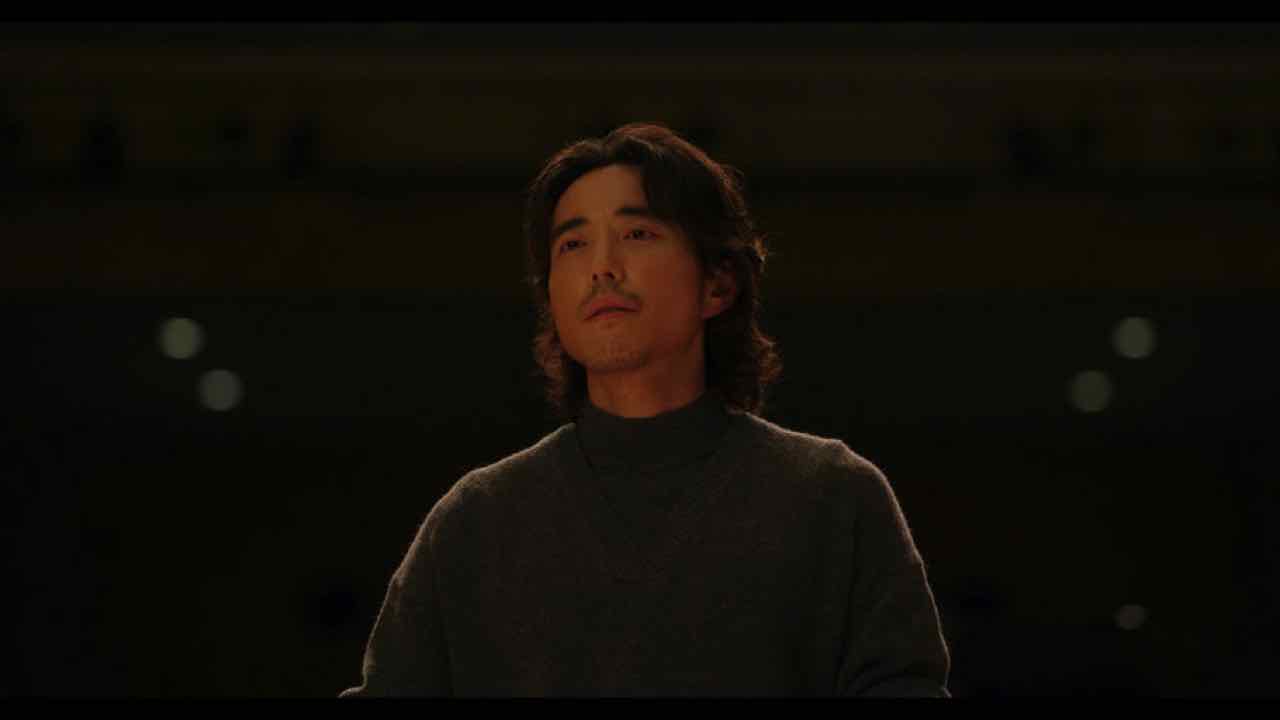
Justin H. Min is also captivating as Min-jun. Casting him as German-Korean is an interesting choice, given that Min himself is Korean-American; his character’s “Germanness” comes through in scattered German words and phrases that feel oddly placed, while the voiceover carries an unmistakably American accent. The character himself remains underwritten—by the time the credits roll, there still isn’t much to know about him—but Min’s performance compensates. Equally strong is Kim Hye-ok as Chun-hee; Kim brings an emptiness and innocence to the role without ever tipping into melodrama.
Thematically, Kim approaches assisted suicide in a way that normalizes a person’s right to a self-determined death. The number of terminally ill patients in South Korea choosing to discontinue medical treatment reportedly rose in 2024, yet stigma remains, and the country continues to ban assisted dying outright.
Kim’s depiction of the adoptee experience, meanwhile, focuses less on Min-jun’s suffering and more on his present life in Korea. He steers away from regret, anger, and guilt; instead, Min-jun is his own person—a music prodigy building a life for himself in Korea. Grief and longing bring Min-jun and Chun-hee together, but their eventual acceptance of one another seals their bond as a makeshift mother and son.
In Journey There, Kim shows why he is one of the most exciting independent filmmakers working today. His humanist approach evokes empathy from viewers and portrays sensitive subject matter with care. The film is an excellent follow-up to his stunning debut, Bori. There, he explored life through the eyes of an 11-year-old CODA (children of deaf adults); here, he turns his attention to someone in life’s final chapter.
• • •

Journey There (Korean: 흐르는 여정)—South Korea. Dialog in Korean and English. Directed by Kim Jin-yu. First released on September 30, 2025, at the 30th Busan International Film Festival. 2hr 3mins. Starring Justin H. Min, Kim Hye-ok, Gong Min-jeung, Park Dae-ho, Kim Jong-goo.
This article is part of Cinema Escapist’s dedicated coverage of the 2026 New York Asian Film Festival.